
GCSE Foundation
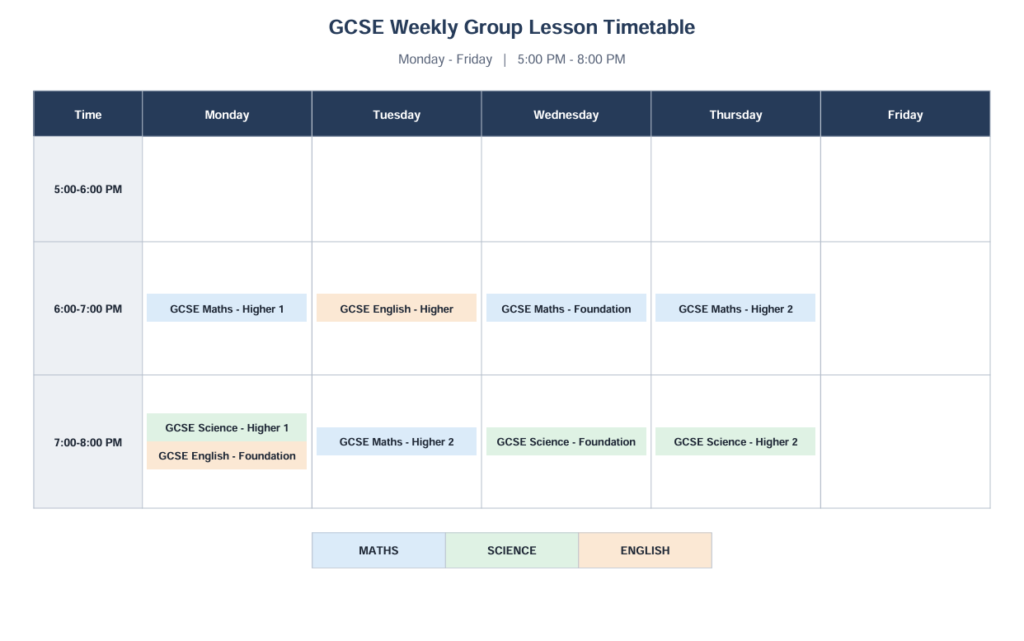
We cover Maths, Science and English, but you can choose only 1 subject, 2 subjects or all.

GCSE Foundation lessons are designed for students working towards GCSE Grades 4 and 5 who want to strengthen their understanding, build confidence and prepare effectively for their GCSE examinations.
Students will cover key Foundation topics across Maths, Science and English, while developing the knowledge and skills required for their GCSEs. Lessons will include focused revision and exam-style practice, helping students improve their technique and become more confident when answering GCSE questions.
Choose the number of subjects your child attends each week:
- 1 Subject £70/Month – Any one from Maths, Science or English
- 2 Subjects £90/Month– Any two subjects
- 3 Subjects £140/Month– All three – Maths, Science and English
Book your lesson with an assessment.
Before joining a group, each student completes a short assessment to help us understand their current level, pace and areas of confidence.
This allows us to place them in the most suitable group alongside students working at a similar level and pace. Our aim is to make sure every student feels appropriately challenged — without feeling left behind or being held back.
What will you learn
Maths
Number
- Integers, decimals & negative numbers
- Factors, multiples, HCF & LCM
- Powers, roots & standard form
- Rounding, estimation & accuracy
Fractions, Decimals & Percentages
- Fraction calculations
- FDP conversions
- Percentages of amounts
- Percentage increase, decrease & reverse percentages
Ratio & Proportion
- Simplifying & sharing ratios
- Direct & inverse proportion
- Best buys & unitary method
- Scale factors & proportional reasoning
Algebra
- Simplifying expressions
- Expanding & factorising
- Substitution & formulae
- Rearranging formulae
Equations, Inequalities & Sequences
- Linear equations
- Simultaneous equations
- Inequalities
- Sequences & nth term
Graphs
- Coordinates & straight-line graphs
- Gradient & intercept
- Real-life graphs
- Distance-time & conversion graphs
Angles & Geometry
- Angle rules & polygons
- Bearings
- Constructions & loci
- Plans & elevations
Perimeter, Area & Volume
- Perimeter & area
- Circles & compound shapes
- Surface area & volume
- Prisms & 3D shapes
Pythagoras & Trigonometry
- Pythagoras’ theorem
- Right-angled trigonometry
- Finding missing sides
- Finding missing angles
Transformations & Similarity
- Reflection, rotation & translation
- Enlargement
- Congruence & similarity
- Scale factors
Measures & Compound Measures
- Units & conversions
- Speed, distance & time
- Density & pressure
- Accuracy & bounds
Statistics
- Averages & range
- Frequency tables & charts
- Scatter graphs & correlation
- Sampling & comparing data
Probability
- Theoretical & experimental probability
- Sample spaces
- Venn diagrams
- Tree diagrams & combined events
GCSE Exam Practice & Revision
- Edexcel past paper practice
- Calculator & non-calculator papers
- Topic-based exam questions
- Exam technique & targeted revision
Science
English
Updating soon!
Why Choose Us
Hybrid Lesson
Attend online or face-to-face at our centre. If you are away, you can still join your class online without missing your regular weekly learning session.
Level-Matched Groups
Every student completes a short assessment before joining, ensuring they learn alongside students with similar ability, understanding and pace, without falling behind or feeling unchallenged.
Lesson Reports
Receive regular lesson reports showing progress, topics covered and areas for improvement, alongside weekly homework designed to reinforce learning and practise important skills independently.
Structured Curriculum
Our carefully planned curriculum builds knowledge and skills progressively throughout the academic year, keeping students on track while preparing them confidently for assessments and GCSEs.
Give Your Child the Support They Need to Succeed
To keep our group sessions focused and personalised, places are limited in each class. Contact us today to secure the right group for your child before spaces fill up.